
Starting date:

How to Create an Amazing Digital Marketing Portfolio
When you think of a portfolio, you may think of an artist or writer. But creating a digital marketing portfolio can be a game changer for marketers.
A portfolio can help you stand out to recruiters and employers if you’re looking for a promotion, a new job, to promote your wares as a freelancer, or start a side hustle.
Most modern marketing roles require a degree of creativity. For example, marketing campaigns require good copy, eye-catching imagery, or great use of video to grab someone’s attention.
Even if you’re in a more data-focused role, it can be important to show how you manipulate information to guide marketing activities and provide insights into customers to enable optimization.
What’s the difference between a CV and a portfolio?
The aim of a digital portfolio website is the same as a CV or resume. It will showcase your education, skills, experience, and professional style through examples of projects or marketing campaigns.
Plus, as a portfolio is digital you can be more creative and it’s easy to link to examples of your work, landing pages or microsites.
What CVs and portfolios have in common is that they allow you to stand out by providing evidence of your skills and achievements. But there are some distinct differences you should know about.
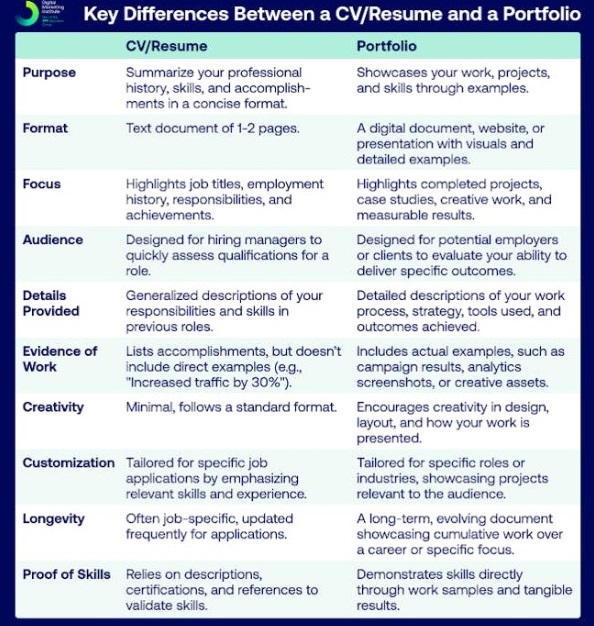
Key differences between a CV and portfolio
How do you know when to use a CV or portfolio?
Whether to use a CV or a portfolio as a marketer depends on the type of role you’re applying for, the stage of the hiring process, and the nature of your work.
CV/Resume
- The starting point for most marketing roles is that employers will want to see a CV or resume
- Ideal for applications when you need to submit a concise document summarizing your qualifications
- Your work isn’t visual so your achievements (e.g., KPIs, analytics results) are best summarized in a CV format
Portfolio
- Ideal for showcasing creative work to potential clients, employers, or recruiters at the interview stage or at application if it’s requested
- Useful in interviews, pitches, or networking to provide proof of your skills and outcomes
- This is particularly important for freelancers or professionals in creative industries (e.g., graphic design, user experience (UX), or content creation)
What should you include in a portfolio?
Before you start creating your digital portfolio, it’s important to know what to include to ensure you’re providing all the information you need to land that job interview or impress your potential new boss.
In terms of how big your digital portfolio should be it depends on where you are in your career and what examples you have to show. The art school Daisie recommends that if you’re just starting out you may not have that many examples so just pick two or three of the best.
If you’re using the portfolio to apply for a job, keep it concise and focused on the role you're applying for. You can showcase more work on your website if you want to showcase a wider range of your work.
Here are the elements that a digital portfolio should include.
Title Page
- Name & Job Title: Your full name and your role (e.g., Digital Marketing Specialist, Social Media Marketer).
- Contact Information: Email, phone number, LinkedIn profile, newsletter, or portfolio URL.
- Professional Summary: A two to three-sentence introduction that summarizes your expertise and unique value.
Table of Contents
List all sections of the portfolio for easy navigation such as:
- About Me
- Key Skills
- Case Studies
- Analytics Reports
- Certifications & Achievements
- Testimonials
- Creative Work Samples
- Contact Information
About Me
Include a brief bio highlighting your background, years of experience, and areas of expertise.
Example: "I’m a Digital Marketing Specialist with 5+ years of experience in content marketing, SEO, and paid media campaigns. I specialize in delivering data-driven marketing strategies that increase organic traffic and drive conversions."
Key Skills
Highlight your top skills as a digital marketer such as:
- Content Marketing (e.g., blogging, video production, email marketing)
- Social media (organic and paid campaigns, retargeting ads)
- SEO (e.g., on-page, off-page, technical SEO)
- Analytics & Reporting (e.g., Google Analytics, Semrush)
Tip: Use icons, bullet points, or percentages to make it visually appealing.
Case Studies
Showcase 2–3 detailed case studies of successful projects.
For each case study, include:
- Client/Project Name (optional for confidentiality).
- Objective: What was the goal of the project? (e.g., "Increase organic traffic by 30% in 6 months.")
- Strategy: Briefly describe the approach taken (e.g., "Developed a content calendar targeting high-volume keywords.").
- Results: Highlight measurable outcomes (e.g., "Achieved a 45% increase in organic traffic and 20% higher conversions.").
Tip: Add screenshots, graphs, or performance metrics for impact and a visual element.
Certifications & Achievements
Showcase certifications relevant to digital marketing.
Examples:
- Digital Marketing Institute certification
- Google Ads Certification
- LinkedIn Learning
- Any awards or industry recognitions for yourself or teams or companies you worked with.
Tip: Use badges, logos, or icons for visual appeal.
Testimonials
If you have them, it’s nice to add testimonials from previous employers, clients, or colleagues. Tip: Use callout boxes or styled text for emphasis.
Creative Work Samples
Showcase examples of your creative output:
- Social media campaigns (e.g., screenshots of posts, engagement metrics)
- Blog posts or articles (links or excerpts)
- Video or graphic design projects (embedded media or links)
- Data visualization projects (graphs or tables)
- Email campaigns (screenshots of emails, open rates or CTR metrics)
- Public Relations activities (links to media coverage or press release examples)
- Paid ad campaigns (screenshots of ads on Google or social media by performance metrics)
- Landing pages or custom websites (links or screenshots)
Tip: Use grids or galleries for a clean layout.
How do you set up a portfolio?
Now that you know the purpose of a portfolio, when to use and what’s included, let's look at the steps you need to take to create one.
1. Select a platform
The good news is that there are many website templates to choose from to kickstart your portfolio design. However, you need to ensure that you choose one that conveys you and your personal brand.
For example, Wix has an AI website builder that can create a bespoke website that offers themes and layouts to choose from.
Example of a website designed by Wix AI
It’s also possible to create your own website using AI tools like Elementor for WordPress and WixStudio.
Top tip: If you’re looking for a community platform to share and showcase your creative work, Behance can help you get discovered by clients and brands. It’s also great for inspiration as there are some amazing examples of work there.
2. Choose a good layout and relevant sections
When picking a layout, think about your product or service. Would a grid format be best to showcase projects or campaigns or would a video in the top block be best?
It’s also important to think about sections. A good ‘About Me’ section can help people learn more about you and your expertise. If you have a newsletter or blog, include sections that promote those or if you’ve got great testimonials or some media coverage, maybe include that as a section.
Take time at this stage as this is the window to your business for prospects and customers. Ensure you have a strong homepage that gives a great first impression and draws people in (see some great examples below).
3. Showcase your best samples
The whole point of this portfolio is to show off your work. So get your samples together and see which ones will work best. Think about text to accompany the examples so you’re qualifying what they are and demonstrating your skills and expertise.
4. Make it easy to contact you
It may sound obvious but it’s important to make it easy for people to get in touch! Include your email or consider including a form people can fill in that goes into your platform inbox. Also, consider adding links to the social media channels you use such as Bluesky or Instagram.
3 Great Examples of Digital Portfolios
It can be tough to know where to start when you’re designing your digital portfolio.
So it’s worth looking at other people’s to get some ideas or inspiration like these examples below.
1) Jordyn Brenner
Screenshot of Jordyn Brenner's digital portfolio
This impressive and extensive portfolio is from Jordyn Brennan, the Creative Director at Amazon Studios.
She uses a grid style to showcase her work with striking images and pop-out colors to grab the eye. Each image is clickable and brings you to another page that explains more about the project.
People can navigate easily to her ‘About page’ which consists of just two lines and an email address - concise and to the point. There are also links to her LinkedIn profile and one that inputs her email address into a browser.
2. Kathryn L. Hall
Screenshot of Kathryn L. Hall's digital portfolio
Kathryn L. Hall is a brand strategist, copywriter, and SEO and SEM expert. In her website portfolio, she splits her services into three categories: technical writing, creative writing, and creative direction.
This helps people find examples of her work quickly but also shows the scope of her skills and expertise. She also has an informal ‘Bio’ section that tells you more about her as a person and her passions along with links to other relevant work.
3) Yan Holtz
Screenshot of Yan Holtz's digital portfolio
Yan Holtz is a freelance senior software engineer specializing in data visualization. His website uses white space to make text and visuals pop and has a more scientific feel about it to tie into his expertise.
The portfolio section of his site showcases his projects through graphs and tables. He also has a blog, newsletter and includes testimonials. There are also several links to other websites that showcase particular projects such as an interactive mini-course to help developers.
Conclusion
While a CV or resume can help you get noticed by an employer, client, or recruiter, a digital marketing portfolio can help visualize your achievements and skills.
Even if you’re not in a creative role, there’s value in having a portfolio as it can present your projects in a way that has an impact, especially at the interview stage where you can use it as a talking point and show off!
Advance your digital marketing career
There’s no better or faster way to break into the digital industry than with a digital marketing certification. DMI’s certified and industry aligned Professional Diploma in Digital Marketing will teach you the fundamentals of digital marketing, show you how to leverage AI in your marketing activities and simple ways to cultivate soft skills. You’ll also explore key channels such as email marketing, social media, SEO, content marketing, and display and video advertising to execute successful marketing campaigns in any industry.
(Source: Digitalmarketinginstitute.com)
RELATED ARTICLES
-
 Why First-Party Data is Important and How Marketers Can Collect and Use it
-
How to Create an Amazing Digital Marketing Portfolio
-
 5+ Best Digital Marketing Schools and Training Providers Today
-
 Self-Study Roadmap for Digital Marketing: From Fundamentals to Advanced Level
-
 Competency Framework for Digital Marketing Professionals
We will support the journey!

VIETNAMESE MARKETERS TO GAIN
THE DMI’S CDMA CERTIFIED & JOIN THE
GLOBAL DIGITAL MARKETERS COMMUNITY

© 2026 PACE Institute of Management. All rights reserved.